WEAVING A NEW RELAND for the 21ST. CENTURY and BEYOND
About the Book
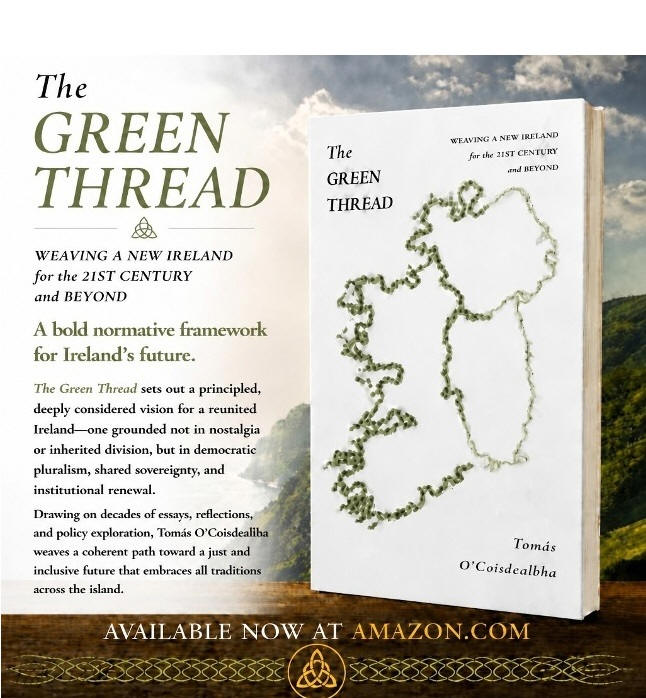
 The Green Thread is an advocacy-oriented policy book
that outlines a vision for a democratic, inclusive, and socially just
reunited Ireland. It argues that reunification should go beyond ending
partition or extending the Republic of Ireland’s existing institutions
northward. Instead, the book advocates a new constitutional settlement:
a federal parliamentary republic designed to distribute political
authority, protect diverse traditions, and provide meaningful regional
representation. It therefore presents unity not simply as a territorial
objective but as an opportunity to build institutions founded on
equality, pluralism, shared sovereignty, and civic participation.
The Green Thread is an advocacy-oriented policy book
that outlines a vision for a democratic, inclusive, and socially just
reunited Ireland. It argues that reunification should go beyond ending
partition or extending the Republic of Ireland’s existing institutions
northward. Instead, the book advocates a new constitutional settlement:
a federal parliamentary republic designed to distribute political
authority, protect diverse traditions, and provide meaningful regional
representation. It therefore presents unity not simply as a territorial
objective but as an opportunity to build institutions founded on
equality, pluralism, shared sovereignty, and civic participation.
The proposed federation would have three autonomous regions: Ulster,
encompassing all nine counties of the historic province; Leinster,
comprising its 12 counties; and Connacht–Munster, comprising the five
counties of Connacht and the six counties of Munster. The book presents
the union of Connacht and Munster as a way to promote economic fairness
and political balance. It argues that each region should control
substantial areas of regional policy while participating in a shared
national government. In the book’s account, this arrangement would
preserve national cohesion without concentrating authority in a single
political center, while giving unionist, nationalist, urban, rural, and
other communities a practical stake in the new state.
A new written constitution would divide powers between the national and
regional governments, while regional authorities would devolve specified
regulatory and administrative responsibilities to county governments and
community councils. The book emphasizes constitutional supremacy, human
rights, equal opportunity, democratic accountability, and safeguards
against excessive central authority. Its proposals also address the
presidency, a representative Council of State, electoral systems,
political parties, courts, policing, regulatory bodies, the civil
service, and other institutions required for a decentralized federation.
Citizens’ assemblies, a charter of rights, and balanced representation
at the national and regional levels are presented as mechanisms for
making reunification a jointly designed process rather than an imposed
outcome.
The book also examines possible locations for national and regional
governments, including the symbolic case for placing a national capital
outside Dublin and Belfast. Beyond constitutional design, it discusses
wealth inequality, housing, uneven regional development, public
services, language and culture, environmental responsibility, and
stronger local democracy. Together, these topics illustrate the book’s
broader argument that reunification should improve everyday governance
and material conditions rather than merely change flags, borders, or
constitutional labels.
The historical chapters connect the proposals to British rule,
partition, the Troubles, the Good Friday Agreement, Brexit, and earlier
federalist thinking such as Éire Nua. The book credits the Good Friday
Agreement with establishing a framework for peace while criticizing its
referendum mechanism and the recurring instability of Northern Ireland’s
power-sharing institutions. It portrays Brexit as a major disruption
that has intensified the constitutional question and exposed tensions
involving trade, sovereignty, identity, and democratic consent. For
implementation, the book envisages approval through referendums,
followed by elections and a managed transition in which existing laws
and public institutions would be reviewed and adapted to the federal
constitution.
Overall, The Green Thread is an openly
persuasive work that frequently criticizes centralized government and
existing constitutional arrangements. It portrays reunification as a
civic transformation rather than a victory for one identity over
another. Its central contention is that a durable united Ireland must be
planned in advance, balanced across regions, responsive to local
communities, jointly shaped by people from every tradition on the
island, and informed by the diaspora.

About the Author
Tomás Ó Coisdealba
What does it mean to carry a nation’s memory across an ocean, then use
that memory to imagine its future?
That question runs through the life and work of Tomás Ó Coisdealbha,
linking his roots in the Irish-speaking west of Ireland with a global
engineering career and a lifelong commitment to political writing,
historical memory, identity, and national renewal.
Ó Coisdealbha was born in Spiddal, County Galway, and raised in a
bilingual household shaped by transatlantic experience. He emigrated to
the United States in 1965 after several years in England. His father,
also a Gaelic speaker, had spent more than 15 years in the United
States, served in its armed forces during World War I, and returned to
Ireland in the 1930s. His mother, a Roscommon native, had also lived in
the United States, where she met and married his father.
That transatlantic background later broadened into a global professional
life. An engineer by profession, Tomás worked for major engineering and
pharmaceutical companies, managing projects across North America,
Europe, West Asia, and the Caribbean. The experiences, observations, and
knowledge he gained during those years gave him a broad international
perspective and shaped his lifelong interest in political organization
and national identity, as well as a distinctive approach to
problem-solving and to working with people who hold different worldviews
and ideas.
Alongside that professional life, he devoted significant time to
political writing, historical research, and the preservation of Irish
republican memory. In The Green Thread, he advances a detailed vision of
Irish reunification grounded in democratic pluralism, regional equality,
and a Federal Parliamentary Republic. He argues that a reunited Ireland
must move beyond inherited divisions by establishing regional structures
that protect local identity, balance political power, and give all
traditions on the island a meaningful place in a shared constitutional
future. His writings reflect a sustained engagement with questions of
sovereignty, federalism, economic fairness, political representation,
and the practical institutions needed to ensure a peaceful, inclusive,
and durable reunification.
The Long Irish Wake, his companion project to be published later this
year, reveals the historical dimension of that same commitment. This
work honors the men and women whose lives were bound to Ireland’s
struggle for national freedom and to America’s enduring struggles for
liberty, equality, humanity, and civil rights. It compiles biographies
and burial-site information for Irish revolutionaries, Irish-American
military figures, and prominent and ordinary exiles whose lives
sustained Irish national consciousness and contributed to the growth and
strength of the United States. By preserving these stories and memorial
sites, Ó Coisdealbha links the memory of past struggle to the civic
questions facing Ireland today. Taken together, The Green Thread and The
Long Irish Wake present him as both a political thinker and a custodian
of historical memory: a member of the Irish diaspora whose work seeks to
honor those who came before while imagining a more democratic and
reunited Ireland.