|
Constitutional Symbols:
Flags and Anthems in
a Reunited Ireland
In the process of creating
a new, reunited Ireland rooted in equality, dignity, and
shared humanity, the Irish people must be prepared to
relinquish the emblems of division, the banners stitched
with bitterness, the covenants that calcified separation,
and symbols that tether us to old wounds.
However, some anchors must
stay. Ireland’s
national flag, the Tricolour, and its anthem Amhrán na
bhFiann, are not symbols of division but beacons of unity.
They transcend the divisions of history, calling forth a
vision of inclusive belonging. These symbols do not exclude;
they invite. They do not dominate; they dignify. In the
architecture of our renewed republic, they are not mere
decorations but foundational pillars bearing the weight of
our shared hope, our inclusive future.
To sacrifice them would
sever the thread of continuity that connects past hope to
future possibility. The flag and anthem must serve as sacred
symbols of Irish freedom, not merely relics but living
witnesses to the men and women, Catholic and Protestant
alike, who have sacrificed their lives for this nation
through centuries of struggle. They are not bargaining chips
to settle imperial debts. They are the heartbeat of a
sovereign people who, through centuries of hardship, refused
to be broken. They must remain untouched by the logic of
appeasement: the quiet surrender of principle for temporary
calm, the erasure of memory for fragile consensus.
For
historical reasons, it’s important to remember that the
national flag, “the Tricolor,” was flown over the General
Post Office (GPO) during the Easter Rising of 1916, and the
national anthem “The Soldier’s Song” was sung by the Irish
Volunteers within.
It’s also
important to remember that both the national flag and anthem
existed before the Northern Ireland state, so there’s no
compelling reason why both should not also postdate its
demise.
The tricolour
was first unfurled in 1848 by Thomas Francis Meagher,
conceived as a gesture of reconciliation: green for
Catholics, orange for Protestants, and white for the peace
between them.
By 1916, its rise
above the GPO transformed it into a symbol of republican
sacrifice and civic aspiration. From its inception, it was
never merely a nationalist emblem: it was a flag of
pluralist intent, a promise of shared belonging in a
sovereign Ireland.
The Irish people
must hold steadfast on this issue, for it anchors Ireland’s
enduring right to nationhood, a right grievously violated by
Britain’s unilateral partition of the island in 1920–21.
That partition, imposed without the consent of the Irish
people, was not merely a political maneuver but a colonial
act of division. It was a textbook ‘divide and rule’
strategy, deployed by perfidious Albion to safeguard
imperial interests and suppress Irish self-determination. In
fracturing the national body, it sowed displacement,
disenfranchisement, and deferred justice;
wounds that still
echo in the civic soul of Ireland.
The
partition of Ireland, justified by Britain as a practical
solution, instead deepened division and dependence. Northern
Ireland, as a six-county entity, lacked the institutional
coherence or democratic legitimacy to operate independently.
Its survival has always depended on British financial
backing and military oversight, a paradox that has fueled a
century-long debate over its political viability.
As Ireland moves
toward constitutional reunification, symbolic clarity must
accompany structural reform.
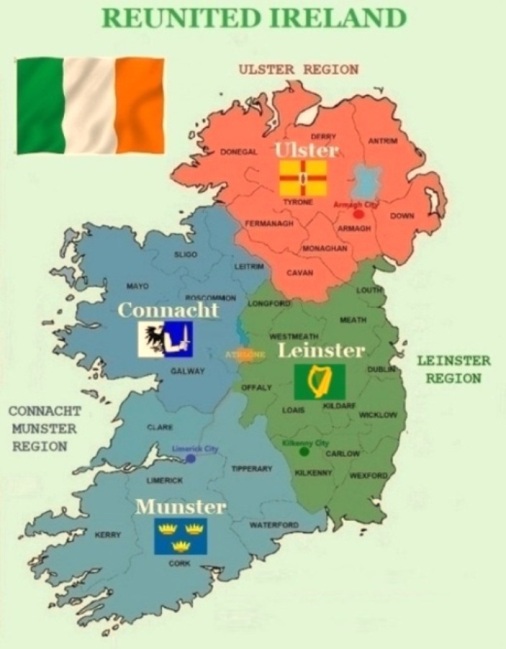
In all federal
regions of a united Ireland, the national flag shall take
precedence. Regional or provisional flags may be displayed
to honor local heritage and identity, but they shall never
replace the national flag in an official setting. When
displayed together, the regional flag would be positioned to
the right of the national flag, symbolizing unity in
diversity and the enduring sovereignty of the Irish
Republic.
Protecting the
national flag’s primacy while allowing meaningful regional
expression balances continuity with pluralism, respects
civic unity, and provides clear, enforceable rules that
reduce symbolic friction during any transition toward
reunification.
--------------------------------------------------------------------------------------------------------------
Ireland's Flags and Banners
|
