|
Ireland
post-partition.
Ireland's
modern history since partition is defined by political division,
conflict, and gradual constitutional transformation. The creation of
the Irish Free State and Northern Ireland set divergent political
trajectories that produced civil war, shifting party systems, and
decades of contested legitimacy and governance. Over time,
constitutional reforms, peace processes, and changing social
attitudes reshaped institutions and public identities across the
island.
The legacy of partition continues to influence
debates over reunification, power-sharing, and citizenship, while
evolving economic and cultural ties have altered everyday life in
both jurisdictions. Understanding contemporary Irish politics
requires tracing how historical ruptures, negotiated settlements,
and institutional adaptations together produced the tangled
political landscape seen today.
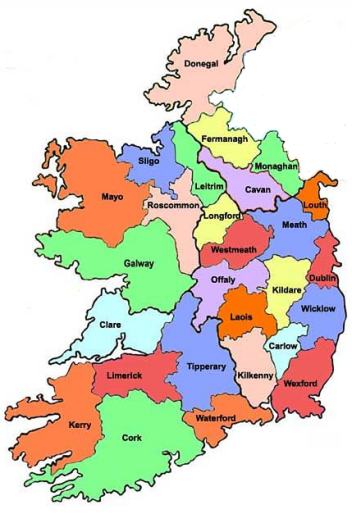 State
formation and partition:
The Government of Ireland Act, passed by the British Parliament in
1920, laid the groundwork for the Anglo-Irish Treaty of 1921.
Signing the Treaty marked the end of the Irish War of Independence.
It also established the division of Ireland into two dominions
within the British Empire: the 26-county Irish Free State and the
6-county Northern Ireland State. The Treaty was approved by the
Second Dáil Éireann and ratified by the Parliament of Southern
Ireland on 12 January 1922. The Southern Ireland Parliament, along
with the Northern Ireland Parliament, was created by the
aforementioned Government of Ireland Act. State
formation and partition:
The Government of Ireland Act, passed by the British Parliament in
1920, laid the groundwork for the Anglo-Irish Treaty of 1921.
Signing the Treaty marked the end of the Irish War of Independence.
It also established the division of Ireland into two dominions
within the British Empire: the 26-county Irish Free State and the
6-county Northern Ireland State. The Treaty was approved by the
Second Dáil Éireann and ratified by the Parliament of Southern
Ireland on 12 January 1922. The Southern Ireland Parliament, along
with the Northern Ireland Parliament, was created by the
aforementioned Government of Ireland Act.
Second Dáil and Treaty acceptance:
The Second Dáil Éireann consisted of members elected in 1921 to the
parliaments of Northern Ireland and Southern Ireland, established by
the British-enacted Government of Ireland Act 1920. Sinn Féin
participated in these elections but refused to recognize the new
Home Rule parliaments, instead redefining them as elections to the
Second Dáil Éireann.
The Second Dáil convened in August 1921 and lasted until June 1922.
Its most notable action was ending the War of Independence by
approving the terms of the Anglo-Irish Treaty with a vote of 57 to
64. Members of Sinn Féin who opposed the treaty left the Dáil.
On January 10, 1922, Arthur Griffith was elected President of Dáil
Éireann. Two days later, as head of the Delegation to London that
signed the Treaty, he called into existence the Parliament of
Southern Ireland to ratify the Treaty and set up a Provincial
Government. The Treaty established the Irish Free State as a
dominion within the British Commonwealth, with an oath of allegiance
to the Crown. This was seen by many as a betrayal of the republic
declared in 1919.
The
Third Dáil and the Free State Constitution:
The
Third Dáil was elected in June 1922 to serve as the Provisional
Parliament of Southern Ireland.
Its primary
function was the adoption of the Constitution of the Irish Free
State,
which consisted of 26 of Ireland's 32 counties.
The Constitution of 1922 was a
compromise document, constrained by the Anglo-Irish Treaty and
British oversight.
The constitution officially came into effect after receiving royal
assent on December 5, 1922. The
adoption of the Constitution marked the legal and institutional
transition from British rule to Dominion status within the
Commonwealth.
The Free State government included the Governor-General, the British
monarch’s representative, the Executive Council, the Third Dáil, and
the newly established Seanad.
After the Irish Free State was established in December 1922, the
Third Dáil became the lower house of the Oireachtas (the National
Parliament). The newly formed Seanad (Senate) became the upper
house. Members of the Executive Council, the Dáil, and the Seanad
were required to take an Oath of Allegiance to the Constitution of
the Free State and declare fidelity to the British Crown.
Civil War:
The
lead-up to the
Civil War began in April 1922 when 200 Irish
Republican Army (IRA) volunteers, led by Rory O'Connor, seized the
Four Courts in Dublin in an attempt to halt the subversion of the
Irish Republic. In occupying the Four Courts, Rory O’Connor and his
comrades made their stand not merely against the Treaty, but in
defense of the Irish Republic proclaimed by Padraic Pearse in 1916
and ratified by the First Dáil in 1919—a vision they refused to see
compromised.
A tense standoff lasted until June 27, when the Free State, under
pressure from the British government, bombarded the Four Courts with
artillery supplied by the British. The
bombardment wasn’t just a military maneuver—it was a symbolic
rupture, marking the definitive split between former comrades in the
fight for independence. The fact that 250 of the 315 deaths were
civilians underscores how deeply the conflict wounded the social
fabric of Dublin and Ireland at large.
After a week of fighting in what became known as the Battle of
Dublin, the Irish Republican Army (IRA) retreated to rural areas,
where they launched a campaign of guerrilla warfare. The
war
ended on May 24, 1923, when Frank Aiken
ordered the
anti-treaty IRA volunteers to cease
fighting and destroy their arms rather
than surrender them, a gesture of defiance and dignity that also
served as a tacit acknowledgment of defeat.
Civil War Aftermath:
The end of
the Civil War closed a chapter of fratricidal violence, yet left
open wounds that would fester for decades. It left a legacy of
bitterness between pro- and anti-Treaty factions, many of whom had
fought alongside each other in the War of Independence. Families,
communities, and political movements were fractured. The wounds
lingered for generations, shaping political allegiances and cultural
memory.
The Free State inherited many British
institutions, including the judiciary and civil service. Using the
machinery of these inherited institutions, the Free State government
enforced strict measures during and after the war, including
executions, internment, and censorship. Over 77 extrajudicial
executions were carried out, including Rory O’Connor’s, who was
executed in retaliation for the assassination of a government member
of parliament (TD).
For decades, the Civil War was a taboo subject in
Irish public discourse. Unlike the War of Independence, it lacked
heroic consensus. Many veterans remained silent, and official
commemoration was muted or avoided. The Civil War shaped the two
dominant parties of 20th-century Ireland, Fianna Fáil and Fine Gael,
whose rivalry echoed the Treaty divide. It delayed deeper
constitutional reform and reconciliation, leaving unresolved
questions about sovereignty, pluralism, and national identity.
Boundary Commission:
The Anglo-Irish Treaty of 1921 contained a conditional clause:
Northern Ireland could join the newly formed Irish Free State unless
its government opted out. On December 7, 1922, just one day after
the Free State’s formal establishment, Northern Ireland exercised
that option, reaffirming its allegiance to the United Kingdom.
This triggered the treaty’s provision for a
Boundary Commission, meant to redraw the border based on demographic
realities, particularly the large Catholic and nationalist
populations in the border counties. However, the Irish Civil War
delayed its creation until 1924, and the Northern Ireland government
refused to cooperate, undermining its legitimacy from the start.
Eoin MacNeill, the Irish Free State’s
representative, struggled to assert influence and resigned before
the Commission’s final report was finished in 1925. The outcome was
a bitter disappointment: instead of transferring
nationalist-majority areas to the Free State, the Commission only
suggested minor adjustments, some even unfavorable to the Free
State. The report was quietly set aside.
Left with no option, the Irish Free State
accepted the established border under the British Government of
Ireland Act (1920). In exchange, Britain agreed to waive Ireland’s
obligation to contribute to Imperial war debts, a significant
financial concession. The Dáil ratified the boundary agreement with
a decisive vote of 71 to 20, ending efforts at territorial revision
and confirming partition.
Political parties:
Cumann na nGaedheal, a right-wing political party, was founded in
1923 by pro-Treaty members of the government and their supporters to
contest future elections. The party held a majority in the Dáil from
1922 to 1927 and was able to form a majority government. After
Fianna Fáil entered the Dáil with a second election in 1927, Cumann
na nGaedheal no longer held a majority and was forced into a
coalition with the Farmers' Party and independent Dáil members to
form a government.
Fine Gael was founded in September 1933 when Cumann na nGaedheal,
the National Centre Party, and the Army Comrades Association merged
to create a new right-wing party led by Eoin O’Duffy. O’Duffy, an
admirer of Italian dictator Benito Mussolini, was the leader of the
Army Comrades Association, also known as the Blueshirts, a
Fascist-leaning group. Under his leadership, the Blueshirts adopted
Fascist-style uniforms and salutes.
Fianna Fáil was founded in 1926 after a motion introduced by de
Valera was rejected at the 1926 Sinn Féin Ard-Fheis. The motion he
presented stated that 'the only Republican objection to the Free
State was the oath to the English King and that if it were removed,
they would enter Leinster House.' Opponents, led by Father Michael
O’Flanagan, defeated his motion with a vote of 223 to 218. De Valera
later resigned as president of Sinn Féin to establish Fianna Fáil, a
new party for the Free State. The new party joined the government of
the Free State in 1927. It won the most seats in the 1932 general
election and formed a government with the support of the Labor
Party. From then on, it remained the leading party in Irish
politics, holding power for 61 of the 79 years from that point until
the 2011 election.
Sinn Féin, a party that has split multiple times since its founding
by Arthur Griffith in 1905, has experienced a resurgence in recent
years, becoming more aligned with right-wing politics. For most of
its history, it was an abstentionist party that refused to
participate in governments perceived to be controlled or influenced
by Britain. After the Good Friday Agreement, the party known as the
Provisional Sinn Féin changed its policy and secretly returned to
its original name, Sinn Féin. In doing so, it dropped its
abstentionist stance and entered Dáil Éireann and the
British-established government in Northern Ireland.
The Labor Party was founded in 1912 by James Connolly, James Larkin,
and William O'Brien as the political wing of the Irish Trades Union
Congress. It is a left-wing party that has formed coalition
governments with both Fianna Fáil and Fine Gael on multiple
occasions over the years.
Reunification challenges:
Apart from the Labor Party, all other established political parties
are right-wing or leaning right-wing. They all claim to support
Irish unity, but none have put forward a plan or program to reunify
Ireland. One could argue that by removing Articles 2 and 3 from the
Constitution as part of the Good Friday Agreement, they accepted the
partition of Ireland as final, a fait accompli.
Irish politicians recognize that reunification would necessitate
altering the current power structure, a change they fear would strip
them of the perks and privileges they've enjoyed since Ireland was
established in 1922. Their rhetorical support for unity, often
expressed in vague terms like “aspiration” or “respect for consent,”
acts as a shield against the structural reforms that reunification
would bring. There is no white paper, no constitutional draft, and
no economic transition plan.
A
federal republic would shift power, give voice to new groups, and
require accountability. That’s not just unfamiliar territory; it’s
hostile ground for parties built on patronage and past grievances.
Politicians worry not just about electoral volatility, but also
about losing control, a worrying prospect for themselves and their
elitist clientele.
The Good Friday Agreement, which removed Articles 2 and 3 from the
Irish constitution,
once the symbolic core of Irish territorial claims,
was seen by many as a constitutional retreat rather than a gesture
of peace and pragmatism, as the Irish government claimed. It also
indicated a retreat from constitutional ambitions, effectively
leaving reunification up to Northern consent without providing a
clear plan or pathway to accomplish it. This passive stance allowed
partition to become a firm political reality. The absence of a
reunification roadmap suggests that the established political
parties have accepted the status quo as permanent, despite changing
public opinion in favor of unity.
Constitutional changes:
In
1931, the British government enacted the Statute of Westminster,
which limited most of the British Parliament's authority to
legislate for its dominions, including the Irish Free State. This
law granted the dominions limited sovereignty to pass their own laws
without oversight from the British government. Encouraged by their
newfound freedoms, the Irish government initiated a push to
transform the Irish Free State into a republic. Actions taken
included:
-
In 1933, the oath of allegiance to the British monarch was
removed from the 1922 constitution
-
In
1936, the Senate was established under the 1922 constitution.
-
By 1936, the role of Governor-General had ceased to exist as a
factor in Irish life.
-
In 1936, all mention of the British monarch was removed from the
1922 constitution
-
In
1937, a new constitution, often referred to by many historians
as the de Valera constitution, replaced the 1922 constitution.
The new constitution was a collaborative effort between the State
and the Church, incorporating input from church leaders,
particularly John Charles McQuaid, who later became the Archbishop
of Dublin and Primate of Ireland. Before the document was submitted
for a public referendum, it was sent to the Vatican for review. Some
of its most controversial articles included,
-
Articles 2 and 3 laid claim to the whole territory of the island
of Ireland, its islands, and territorial seas. In reality, it
was meaningless, as it did not alter the status of Northern
Ireland.
-
Article 4 changed the name of the state from Saorstát Éireann
(Irish Free State) to Eire (Ireland)
-
Article 41, couched in language to obfuscate its misogynistic
content, Article 41 subordinated the role of women in Irish
society to that of men.
This
has been interpreted by many to mean that the woman’s role was
primarily limited to the domestic sphere, specifically the
kitchen.
-
Article 44 recognizes the special position of the Holy Catholic
Apostolic and Roman Church as the guardian of the Faith
professed by the great majority of the citizens.
In 1948, the Irish government enacted the Republic of Ireland Act to
eliminate the remaining statutory role of the British monarch in the
state. In describing itself as a republic, all ties with the
British Commonwealth were severed in accordance with British law.
However, the country's name remained unchanged as 'Eire' (Ireland)
was codified in the 1937 constitution. The following three sections
of the Act are as follows.
-
This
Act shall come into operation on such day as the Government may
by order appoint.
-
This Act may be cited as the Republic of
Ireland Act, 1948.
In subsequent amendments to the 1937 Constitution, some of the
aforementioned controversial articles were revoked or amended as
follows:
-
Articles 2 and 3 were removed by the Good Friday Agreement.
-
Article 41 was amended in 2006 when divorce became legal in
Ireland.
-
Article 44 was amended in 1972 to remove any mention of a
special status for the Catholic Church.
International relations:
Ireland joined the United Nations in December 1955. The European
Economic Community (EEC) was established by the Treaty of Rome in
1957. When the European Union (EU) was created by the Maastricht
Treaty in 1993, the EEC was integrated into the EU and renamed the
European Community (EC). In 2009, the EEC officially dissolved, and
its institutions were incorporated into the EU.
In 1961, Denmark, the UK, and Ireland applied for membership in the
ECC. France vetoed all three applications in 1963. In December 1965,
the Anglo-Irish Free Trade Agreement was signed after France vetoed
their EEC application.
In 1967, Denmark, the UK, Norway, and Ireland submitted their second
application to join the ECC. In 1972, after numerous delays,
extended negotiations, and the death of de Gaulle, Ireland, Denmark,
and the UK signed the Treaties of Accession and officially joined
the EEC in 1973.
Northern Ireland conflict:
The
thirty-year conflict in Northern Ireland, often euphemized as “the
Troubles,” was not a sudden outburst of sectarian violence. It was
part of a long and painful history of resisting foreign control.
This legacy began with the Anglo-Norman invasion of 1169 and grew
through centuries of colonization, dispossession, and division.
To reduce this conflict to a mere Catholic versus
Protestant dichotomy is to erase its deeper truths. It was a proxy
war over who gets to define legitimacy, citizenship, and belonging
on the island of Ireland. It was a contest between imposed
structures and indigenous aspirations—a generational trauma that
scarred communities, fractured families, and left a legacy of grief
that still reverberates.
The British
state’s framing of the conflict as a security issue masked its
constitutional and existential aspects. For many in the nationalist
and republican traditions, the fight was not for dominance but for
dignity and the right to live in a society that reflects their
history, values, and civic identity. For unionists, it was about
defending their cultural continuity and perceived security within
the United Kingdom. But the structures that governed Northern
Ireland—especially under Stormont—were not neutral arbiters; they
served as tools of exclusion and inequality.
Thirty years of conflict essentially ended with the signing of the
Good Friday Agreement (GFA) by the British and Irish governments in
1998. At best, the GFA offered a framework for peace, but not a
resolution of the underlying constitutional question. It deferred
sovereignty rather than resolving it. The trauma of the conflict
endures not just in memory, but also in the architecture of
governance, in the silences of public discourse, and in the
unfinished business of reconciliation.
The total number of lives lost during the conflict totaled 3,532
Ireland’s economic exodus:
“Most
countries send out oil or iron or steel or gold or some other crop,
but Ireland has had only one export, and that is its people.”
John F. Kennedy on his presidential visit to Ireland in June 1963.
Ireland has experienced significant emigration over the past two
centuries, with about ten million people leaving since 1800.
Economic conditions and emigration have been linked since partition.
From the time of Ireland's partition until the 1950s, the Irish
economy was primarily based on rural agriculture, with a strong
focus on exporting agricultural products to the United Kingdom.
Fiscal policy was conservative and remained so throughout the 1950s.
Public finances were greatly supported by England’s cancellation of
Ireland’s share of Britain’s imperial debts in exchange for Ireland
accepting the original Northern Ireland/Southern Ireland border.
During that period, emigration was a common occurrence. In the
1920s, political retribution following the Civil War and a stagnant
economy contributed to this trend. In the 1930s and 1940s, a
prolonged economic conflict with England, along with World War II,
led to an increase in emigration to England—some to join the British
army, others to work in factories and hospitals, and after the war,
to help rebuild English cities.
The late 1940s and the 1950s were a remarkable era of mass
emigration. Over 500,000 people left Ireland between 1945 and
1960—clear evidence of the poor state of the Irish economy at that
time. Little changed from then until the late 1980s. Low economic
growth, misguided fiscal policies, protectionism, and sometimes
corrupt governments had widened the gap between Ireland and the rest
of Western Europe. By the mid-1980s, Ireland was experiencing a
19.6% unemployment rate, had the highest debt per capita in the
world, and its nation's GDP per capita was only 63% of that of its
neighbor, the United Kingdom. At that time, the Irish were referred
to as the beggars of Europe.
The economy and the Celtic Tiger:
The economic situation underwent a dramatic transformation during
the 1990s, as Ireland experienced a remarkable rate of growth.
Between 1990 and 1995, Ireland's economy grew at an average annual
rate of 5.14%. From 1996 to 2000, the rate of increase averaged
9.66% annually. By the end of the decade, unemployment dropped to
4.5%, and the nation's GDP per capita stood at €25,500. In just over
a decade, Ireland transformed itself from one of the poorest
countries in Europe to one of the EU's wealthiest countries.
Ireland's economic boom during that period is known as the Celtic
Tiger. Yet beneath the glittering
metrics of prosperity, Ireland’s foundations remained dangerously
exposed.
When the global downturn hit, Ireland’s overexposure to property and
its dependence on volatile capital flows triggered a domino effect;
the collapse of the building industry wasn’t just an economic issue;
it was a civic one. Communities were hollowed out, public trust
eroded, and emigration surged once again.
Ghost estates
became monuments to hubris, while young families fled abroad,
disillusioned and displaced.
The Celtic Tiger’s collapse wasn’t just caused by global forces: it
was driven by intentional domestic choices. Ireland’s tax breaks and
lenient regulations fueled a speculative frenzy, particularly in the
real estate sector. The government, intoxicated by short-term
growth, failed to establish resilient fiscal structures and protect
against systemic risks. Banks operated without oversight, and the
government, rather than acting responsibly,
advocated for unsustainable growth.
The Celtic
Tiger’s collapse revealed not just economic fragility, but a deeper
constitutional void: one where short-term gain eclipsed long-term
stewardship.
The Celtic Tiger’s
implosion was not merely a failure of economics: it was a failure of
vision. It exposed the absence of constitutional safeguards that
prioritize long-term resilience over short-term gain. If Ireland is
to build a truly pluralistic and sovereign republic, its fiscal
architecture must be grounded in foresight, equity, and civic
responsibility. Economic policy must serve the people: not market
whims or political cycles. Only then can Ireland transcend the
ghosts of speculative excess and chart a course toward enduring
prosperity.
The Diaspora: Ireland’s Forgotten
Citizens:
Since its founding in
1922, Irish governments have treated emigrants as peripheral—valued
for remittances, celebrated in cultural diplomacy, but denied
political relevance. The lack of voting rights for citizens abroad
is not just an administrative issue; it is a civic wound. It breaks
the constitutional bond between citizen and state, reinforcing the
idea that Irish identity depends on physical presence rather than
shared purpose.
Today, with millions of Irish-born or
Irish-descended citizens living abroad, Ireland still lacks a
coherent strategy to include them as stakeholders. No major party
has prioritized diaspora enfranchisement. Welfare support remains
minimal. Consular services are limited. The message is clear: once
you leave, you exit the national conversation.
This neglect is not only unjust but also
strategically counterproductive. The diaspora represents a reservoir
of talent, capital, and global insight. Excluding them weakens
Ireland’s democratic legitimacy and wastes a crucial resource for
national renewal. A pluralist republic must broaden civic belonging
beyond borders. Anything less is a betrayal of Ireland’s promise.
In the final analysis, one may ask: How can a
nation that aspires to project soft power, shape global narratives,
or lead on the world stage afford to neglect its diaspora: those who
carry its culture, values, and reputation across borders?
|
